
How Franklin City Property Records Fit Together
Begin with the question you want answered. In Franklin City, an address or an owner name leads first to the Commissioner of the Revenue's real-estate assessment portal. The parcel record there gives a stable parcel identifier. It also shows the assessed owner, situs, mailing details, assessment figures, and sale information as the portal presents them. Use that parcel key in the land-record index. The map viewer adds location context. A Franklin City property search is really a route across these separate systems, not one joined database.
The most useful order runs assessor, circuit land records, Treasurer, then map. Each office does a different job. An assessment roll is not a deed. A tax bill is not proof of title, and a parcel outline is not a surveyed boundary. Names vary too. A name can appear in several forms, especially when an estate or a business entity holds title. Keep the parcel number and legal description beside your notes so every result points to the same land in Franklin City.
- Find the parcel in Franklin City of Franklin Vision assessment portal using the street address or owner information available in its search screen.
- Record the parcel number and compare the situs and mailing fields with the address you began with.
- Search Virginia SRA or COVERS for the latest land instrument tied to the owner and locality.
- Check the Treasurer’s tax pages for installments, delinquency notices, or sale information.
- Open CivQuest or Atlas for map context, then use the deed or a survey for legal boundaries.
The Offices Behind Franklin City Property Records
Franklin City is an independent city, not a locality under Franklin County government. The correct first stop for local real-estate assessments is one office. That is the Franklin City Commissioner of the Revenue. The Commissioner keeps the roll. The Franklin City Treasurer handles bills and tax-sale notices, along with payments and delinquency lists. Deeds, deeds of trust, releases, liens, and plats are circuit-court records under Virginia's Clerk of the Circuit Court model. The office is not called a county recorder. City mapping services provide a public visual reference.
Franklin City splits the work because roll, bill, deed, and map live in different systems. Each custodian fixes only its own record. A field may look wrong. A document may be missing. Contact the office that owns the record. The city publishes no exact land-record counter assignment. No copy fee schedule appears either. Don't ask a general court desk for a deed. It cannot certify one for a Franklin City parcel.
Commissioner of the Revenue
City Hall, 207 W. 2nd Avenue
Franklin, VA 23851
757-562-8548
City Treasurer
City Hall, 207 West 2nd Avenue
Franklin, VA 23851
757-562-8536
Fifth Judicial Circuit Land Records
Virginia SRA and COVERS
Local counter details not located
Confirm with the circuit clerk
Franklin City Property Records in the Vision Roll
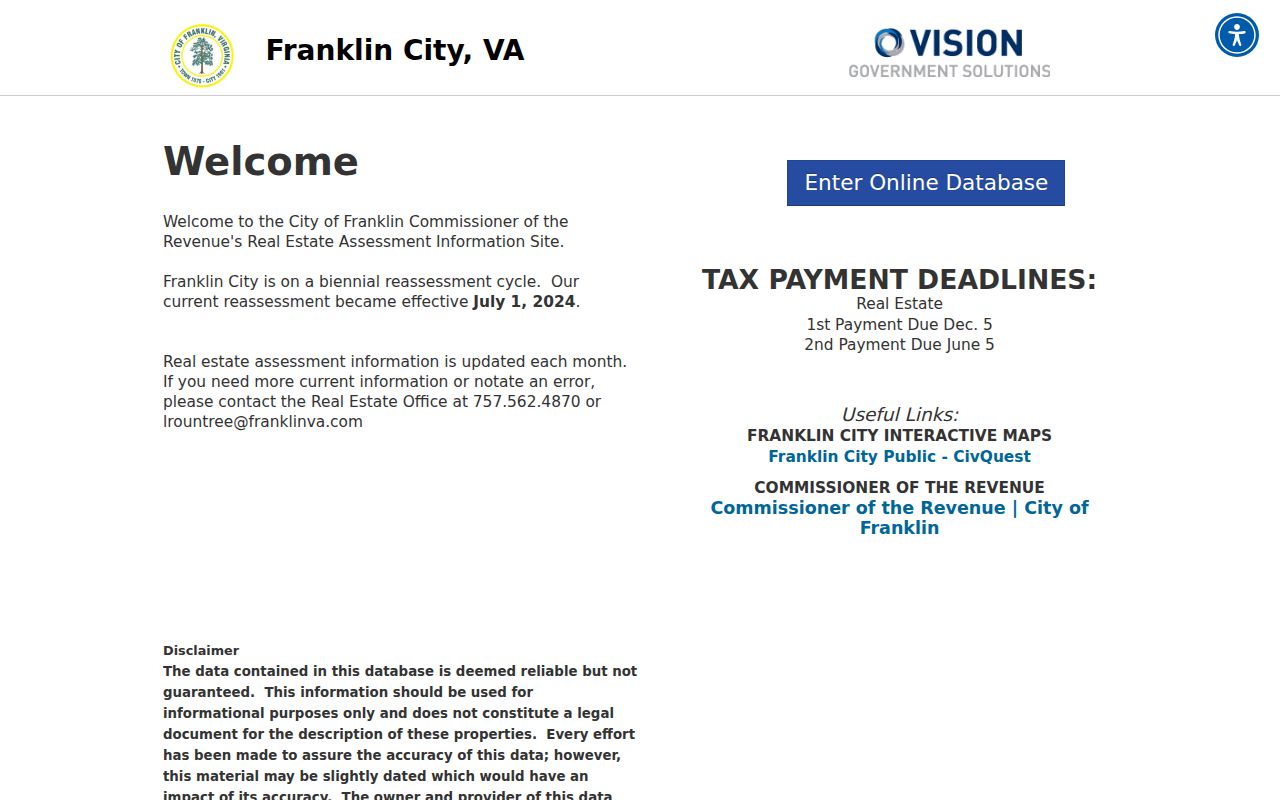
The Commissioner's real-estate system runs on Vision Government Solutions hosting. Franklin City reassesses real estate on a biennial cycle. The current reassessment takes effect July 1, 2024. The portal notice also says real-estate information is updated monthly. Those are two different clocks. A reassessment lands on its stated cycle, while roll details shift through the year as the office updates records.
A monthly refresh does not mean every recent sale appears at once. Use the portal as the starting record. It answers an owner-of-record question and supplies the current assessment. The landing screen offers an "Enter Online Database" action. Field labels appear only inside the search interface. Trust only what the live screen shows. So do not promise a filter, export, sketch, or sale-history field for a Franklin City parcel search. If a recent transfer is missing, check the newest recorded deed instead of treating the roll as a real-time title system.
For assessment corrections in Franklin City, contact the Commissioner. The city site links tax relief and land-use functions through its Housing and Real Estate page. The portal's own disclaimer says the data is for reference, not a legal property description, may be slightly dated, and is not guaranteed. The roll is a finding tool. That is why it helps you locate Franklin City property records but cannot settle a boundary or title dispute.
The Vision assessment landing page shows the public entry point and the current cycle notice. No sample parcel result appears on the landing view. Treat it as a portal guide rather than a model of every result field.
The monthly refresh explains the lag. If timing matters, verify a Franklin City transfer in the circuit-court land-record index.
Franklin City Property Records and Parcel Numbers
A parcel number is the best cross-system key a Franklin City researcher can hold. Street names shift and repeat. The parcel number does not. One public example: the 2026 Treasurer tax-sale notice lists parcels 137-81-18 and 137-81-20. Those two are illustrations from the notice. They are not a guide to how every Franklin City parcel is numbered. Copy the identifier exactly as it appears on an assessment result, tax notice, or deed reference. Never guess a neighbor's parcel number by swapping the final digit. That shortcut produces errors, not leads.
Address searches can return more than one hit. When that happens, line the parcel number up against the situs address. Then check the legal description until one match stands out. Carry that same identifier into the map viewer and into your notes for the SRA search. The parcel number is also handy for separating a property from a person. This matters most when someone has a common name. Still, it cannot prove ownership on its own. Ownership questions call for the legal description and the recorded instrument. This is especially true in a purchase, an estate matter, or a boundary dispute. A tax sale where the exact tract matters demands the same care.
Franklin City does not offer one joined search across its records. The assessor portal, the tax pages, the land-record index, and the GIS viewer each run on separate screens. Each also has separate terms. Keep the parcel number stored alongside the instrument or book-and-page reference. Note the date you checked each source. An older deed sometimes shows a parcel number that differs from a current map label. Before assuming the tract changed, read the legal description and the annexation history.
What Franklin City Property Records Show Across Systems
Each Franklin City record answers a different piece of a property question. A deed documents an instrument recorded in the circuit system. An assessment record names the owner of record. It also gives the value used for local administration. A bill shows a tax obligation. A GIS map supplies geography. The records reinforce one another, but none stands in for the rest.
| Record | Useful for | Custodian or access path |
|---|---|---|
| Assessment roll | Owner of record, parcel, situs and mailing details, values and assessment context | Commissioner of the Revenue and Vision portal |
| Deed and land instruments | Recorded transfer, grantor and grantee, legal description, liens or releases | Clerk of the Circuit Court through SRA or COVERS |
| Tax bill and delinquent list | Installments, payments, listed delinquency, sale notices | City Treasurer |
| Parcel map | Parcel location and surrounding map context | CivQuest and Atlas map viewer |
| Planning and land-use file | Zoning, site-plan or development review material when held by Franklin City | Community Development; no indexed permit database was located |
For a wide-angle lookup, the Franklin City property search guide walks the address-to-parcel route. Recorded transfers and releases live elsewhere. Go to the circuit land-record index for those instead of the assessment roll.
Why a Franklin City Deed Can Be Newer Than the Roll
The assessor and the circuit clerk record different things. A deed enters the system as a land instrument. The assessment database exists for valuation and tax work. The assessment notice says its information is updated monthly. So a recent sale can leave the newest deed naming a grantee. The online roll may not catch up right away. That gap is a practical possibility, not a stated average delay for Franklin City.
Comparing the two takes a set order. Start with the roll to pull the parcel and the current owner name. Then search the circuit index for the latest deed matching that parcel's legal description. Read the grantor, grantee, instrument date, recording reference, and locality. Deed images are not always online. The index may still show a reference. An authorized image or clerk copy can require a subscription or an in-person request.
A monthly refresh is not a legal rule about when ownership takes effect. Records get corrected. An instrument can be indexed under a different party name. A trust or entity name may not match the person who handled the deal. Conflicting results call for a question to the clerk or Commissioner. Ask which record needs fixing. Treat the index and the roll as research aids. A title professional can review the full chain.
Franklin City Tax Bills, Installments, and Delinquent Lists
The Franklin City Treasurer collects the real-estate bill and posts delinquent lists and sale notices. Real-estate installments are due June 5 and December 5. The Commissioner page carries the real-estate tax rate, while the Treasurer page handles payment and delinquency details. Keep those roles straight: an assessed value comes from the Commissioner, and a balance or payoff question goes to the Treasurer.
A delinquent PDF can be a useful lead, but the city cautions that its posted lists dated October 11, 2023 leave out penalties and interest. A PDF is a dated snapshot, not a live payoff quote. Call the Treasurer for the amount due and confirm the parcel before acting. A payment portal linked from the City’s Housing and Real Estate page sits apart from the assessment search, and its account fields may differ.
The 2026 sale notice shows how much more a sale file can hold than a delinquent balance. It describes an online-only sale, full payment on sale day, a 15 percent buyer’s premium, and a 200 dollar deed-recording fee. It also warns about easements, liens, boundary questions, environmental issues, and other recorded or unrecorded matters. Those terms call for independent title and survey review.
The Treasurer’s office page links the delinquent lists and contact details. The listed City Hall address is 207 West 2nd Avenue, Franklin, 23851, with weekday hours of 8:30 a.m. to 5 p.m.
Note: Confirm any listed balance with the Treasurer before relying on a PDF.
Franklin City’s Independent-City Boundary Matters
Names matter in a search box. Franklin City is an independent Virginia city. Franklin County is a different locality in the western part of the state. A Franklin City address belongs in the City assessment system and the land-record system that serves the city. It does not belong with the Franklin County Commissioner or clerk. Searching the wrong office is the fastest way to get a false "no record" result. That can happen on a parcel that exists.
Court geography adds another wrinkle. Franklin City sits in the Fifth Judicial Circuit with Isle of Wight, Southampton, and Suffolk. That grouping shares no assessment roll. When a land-record system lets you pick a locality, choose it carefully. Compare the legal description. Do this before trusting that a result really belongs to a Franklin City parcel.
Custody splits here, as it does across Virginia. Circuit clerks hold the land instruments, while Franklin City departments handle assessments, taxes, planning, and maps. No single courthouse keeps every file. The practical approach is to identify the custodian record by record. Then reconcile each result by parcel number and legal description. The Virginia judicial circuit map confirms the Circuit 5 placement. It explains court administration only, not tax boundaries or who owns a parcel. Use it for routing, then verify the land-record locality in SRA.
Older Franklin City Addresses and Annexation History
Franklin grew as a trading post near the navigable head of the Blackwater River. Rail lines later tied the area to wider markets. It became an incorporated town in March 1876. It annexed land in 1960, gained city status in 1961, and annexed again in 1986 and 1996. So a property's modern street label may not match the place name written in an older deed. It may not match the recorded jurisdiction either.
That history pays off when a modern Franklin City search misses an older instrument. Search the exact parties and compare the legal description rather than the current mailing address. An old deed may name Southampton County instead. Or it may describe a tract by a road, creek, railroad, or named parcel. Today's map can orient you to the land. It cannot rewrite the legal description that was recorded.
Commercial parcels carry some of this river and rail context in their records. The Blackwater trade route and rail service shaped local growth. Treat that as a clue, not proof of any particular use. A solid house history combines recorded deeds with historic plats, tax or land books, and archival material. Look for those records where they survive.
Franklin City Property Records and GIS Limits
Franklin CivQuest and the Atlas viewer give map context for Franklin City parcels. The City's disclaimer states plainly that map information derives from public records. It is not a survey or legal representation. A colored parcel outline can help you locate a tract. It can help you compare nearby parcels or find a parcel number. It cannot fix the exact boundary, acreage, access rights, or a line on the ground.
Run the map after the assessment search has handed you a parcel key. If the viewer and the deed seem to disagree, compare the deed description against any recorded plat. A fence dispute, encroachment, purchase, or boundary question calls for a current survey from a licensed surveyor. The City map is a planning and orientation aid. It is not an appraisal. A building or road drawn on the map does not confirm ownership of that feature.
Map layers and interactive tools vary. Do not count on an adjacent-parcel button, export feature, or buffer tool until you see it on the live viewer. If the online interface does not answer your question, ask City GIS or Community Development staff what map or public file they can supply.
Requesting Franklin City Property Records That Are Not Online
Go straight to the office that holds it. The Commissioner takes assessment questions. The Treasurer handles bills and payoff figures. Deeds and other land instruments belong to the circuit clerk. Zoning, site-plan, and permit files start with City planning or Community Development. The City publishes no searchable permit database. It posts no cutoff year for its online deed index and no exact copy fees for the land-record counter.
Virginia's Freedom of Information Act, Va. Code sections 2.2-3700 through 2.2-3714, governs public-record requests, with exemptions and fee rules that depend on the request and the record. Name the parcel number and address. Add the record type and date range. Ask first whether the office has a standard request form and whether inspection or copies are available. A request for an assessment card will not pull the recorded deed image.
In Franklin City, keep each request narrow and save the response. An exemption can withhold or redact a record. Some court and personal records carry added limits. Otherwise the Library of Virginia is a gateway to historical state and locality materials. Check its catalog for the exact city collection first.
Limits of a Franklin City Property Records Search
Franklin City property records support ownership research, tax review, civic questions, and property history. They have limits. A deed chain may still have gaps. An assessed value is not a likely sale price, and a map line is not the legal boundary. The City's own assessment portal notes that its data is informational and may be slightly dated. Check any search result against the custodian's current record.
Use records lawfully. A Franklin City owner name or mailing address is for property research and civic use. Do not use records to stalk, threaten, target, or harm a person. A title question belongs with a title professional, a boundary question with a licensed surveyor, and a certified record request with the custodian.